Scroll
EXHIBITION DATES : In person and online from 18/7 – 29/8

INTRODUCTION :
“The man and the beast are one cloth.”
Here - where memory is held in stone and sea and whispered on the wind—stories were once told of the animals who moved between worlds. These myths reflected our deeper relationship - of an inherent knowing kinship or oneness with all living beings. In ‘Cad Goddeau’, the 6th Century Welsh poet Taliesin wrote “I have been a stag, a salmon in a pool, a dog, a roebuck on the mountain... I have been all these things.” This sentiment is shared across time and cultures, from the Siberian taiga to the distant Australian desert where shamans, elders, and healers have and continue to speak, although in decreasing number, of the same truth: Animals are not “other.”
Bonaparte the Pig may well be right when he claimed in Orwell’s ‘Animal Farm’ that "Four legs good, two legs bad.” Today, in the shadow of ecological collapse, a murmur of so called 'older ways' should perhaps be heard louder than ever. Our Earth is burning, drowning, breaking under weight of progress. Species vanish daily. And behind every extinction is a broken relationship. Science now supports what ancient teachings have always held: That we are not separate from the Earth. We are participants in a shared system - body, breath, and being. This is not poetic concept, It is scientific imperative. Earth is undergoing a sixth mass extinction, driven by habitat loss, climate change, and industrial exploitation. Since 1970, global wildlife populations have declined by 69% on average. These losses are not isolated. When a species disappears, it tears holes in our ecosystems—and in ourselves.
This exhibition will invite you to listen to the animal, and to see something inside yourself. To remember that the wolf, the whale, the bird, and the human all breathe the same air.
“We are not separate spirits. We are one spirit walking in many bodies”

ONLINE CATALOGUE :
The exhibition includes artworks by (In alphabetical order) : Sam Bassett, Paul Benney, Jim Carter, Kate Clark, Judith Nangala Crispin, Claire Curneen, Lena Dabska, Miles Cleveland Goodwin, Andrew Hardwick, Andrew Litten, Antony Micaleff, Jamie Mills, Tom Pether, Dr Martin Shaw, Tim Shaw, Oleksii Shcherbak, Kate Walters, David Kim Whittaker, Joy Wolfenden Brown, Faye Eleanor Woods
EXHIBITION INSTALL IMAGES :


EXHIBITION ARTWORKS (CLICK FOR FULL DETAILS :
Featured

£0.00
Artist : Lena Dabska
Title : Orchid
Medium : ecoline & ink on paper
Dimensions : 30 x 21 cm
ENQUIRE ABOUT THIS WORK
Lena Dabska is a Polish artist currently in her fourth year of study at the Academy of Fine Arts in Warsaw. Her practice centres around an expansive exploration of femininity and feminine power, informed by personal experience and a deep intuitive connection to nature. At the core of her work lies a belief in womanhood as a primal, untameable force. Through ongoing experimentation, while remaining grounded in the intuitive, bodily, and symbolic, her work offers a vision of feminine energy as both fierce and nurturing — a return to source. Recurring totemic motifs embody strength, freedom, and an ancient, sacred femininity. A sense of mythic vitality persists — a reminder of the shared lineage between humans and the natural world.

£0.00
Artist : Kate Clark
Title : Rivalry
Medium : baboon hide, foam, clay, pins, thread, rubber eyes, rope
Dimensions : 208 x 92 x 92 cm
ENQUIRE ABOUT THIS WORK
Kate Clark creates sculptures that provoke primal, instinctive responses, inviting viewers to reflect on their own humanity. By stitching ethically sourced animal hides over hand-sculpted human faces, Clark fuses human and animal into a single form — evoking both identification and unease. Her work explores the tension between our evolutionary past and our contemporary selves, suggesting that full awareness of the human condition requires an acknowledgment of our animal inheritance.
Clark lives and works in Brooklyn, New York. She holds a BFA from Cornell University and an MFA from Cranbrook Academy of Art, and has received fellowships from the Jentel Foundation, the Fine Arts Work Center, and the Marie Walsh Sharpe Studio Program. Her work has been shown in numerous solo and group museum exhibitions across the U.S. and internationally, and is held in public and private collections including JP Morgan Chase, the 21c Collection, and the David Roberts Art Foundation. Clark’s sculptures have been widely featured in the press, and were the subject of a National Geographic documentary filmed in her studio.

£0.00
Artist : Kate Clark
Title : The Sisters’ Embrace
Medium : coyote hide, foam, clay, pins, thread, rubber eyes
Dimensions : 122 x 89 x 36 cm
ENQUIRE ABOUT THIS WORK
Kate Clark creates sculptures that provoke primal, instinctive responses, inviting viewers to reflect on their own humanity. By stitching ethically sourced animal hides over hand-sculpted human faces, Clark fuses human and animal into a single form — evoking both identification and unease. Her work explores the tension between our evolutionary past and our contemporary selves, suggesting that full awareness of the human condition requires an acknowledgment of our animal inheritance.
Clark lives and works in Brooklyn, New York. She holds a BFA from Cornell University and an MFA from Cranbrook Academy of Art, and has received fellowships from the Jentel Foundation, the Fine Arts Work Center, and the Marie Walsh Sharpe Studio Program. Her work has been shown in numerous solo and group museum exhibitions across the U.S. and internationally, and is held in public and private collections including JP Morgan Chase, the 21c Collection, and the David Roberts Art Foundation. Clark’s sculptures have been widely featured in the press, and were the subject of a National Geographic documentary filmed in her studio.

£0.00
Artist : David Kim Whittaker
Title : Prisoners of Time
Medium : oil and acrylic on canvas
Dimensions : 180 x 140 cm
ENQUIRE ABOUT THIS WORK
Most of David Kim Whittaker’s paintings are based upon a metaphysical interpretation of the human head. These portrait-portals are often ambiguous in gender and identity, aiming to represent the totality of the human condition - the universal where the cruel and the empathetic are held in tension with personal experience. The works juggle dual states of inner and outer calm and conflict, offering glimpses of simultaneous strength and fragility, conscious and subconscious, masculine and feminine. They embody Whittaker’s ongoing effort to express something far greater than the individual self. In this particular painting, that metaphysical interior is densely populated with layered symbolism—mountains, flowers, vessels, and embedded animals. The creatures featured were all inhabitants of Kyiv Zoo at the onset of war in Ukraine, their presence a quiet, haunting witness to the ongoing human destruction. These creatures - some partially obscured, some emerging from the tangle of memory and architecture - become emblems of loss, innocence and endurance, evoking both a spiritual kinship and the silent toll of conflict. The head becomes a sanctuary, or perhaps a site of reckoning, where personal reverie and geopolitical trauma converge. This painting, like much of Whittaker’s recent work, reflects a deepening sensitivity and unease in response to escalating global tensions. It is a dual mirror—one side hope, the other warning—staring back from the frame with quiet insistence.
Whittaker is a British artist born in Cornwall, where they continue to live and work. Exhibitions have been held internationally, including a major solo exhibition at Fondazione Mudima in Milan in 2017. Their work is represented in numerous museum and private collections worldwide. In 2011, Whittaker was awarded the Towry Prize (First Prize) at the National Open Art Competition.

£0.00
Artist : Antony Micaleff
Title : Untitled
Medium : oil on canvas
Dimensions : 48 x 40 cm
ENQUIRE ABOUT THIS WORK
Antony Micallef is a British contemporary artist working in London, UK. He first appeared on the British art scene after becoming a prize winner of the BP Portrait Award competition at the National Portrait Gallery. Since then, his oevre fused political imagery with contemporary expressionism winning him worldwide acclaim. Micallef roots his visually charged figurative paintings in the fields of social commentary and physical and metaphysical self-examination in the search to capture something of the human condition. In his more recent works, he builds up a substantial relief-like surface with extensive paint mass sited upon a benign background. By using significant layering, and heavy impasto, the materiality of his medium is pushed to its extreme, blurring the physical boundaries between painting and sculpture.
Micaleff was taught by the painter John Virtue, who was in turn taught by Frank Auerbach. He has was selected as one of Louis Vuitton’s ‘Visionaries’ and as a visual collaborator with Peter Gabriel for his ‘i/o’ album project and live tour. His paintings features in private and public collections across the world including the permanent collection of Damien Hirst and the London design museum, with work exhibited in institutions including The National Portrait Gallery, The Royal Academy, Tate Britain and the ICA.

£0.00
Artist : Tom Pether
Title : Neither Nor
Medium : antler, fake fur, wax, wire, concrete
Dimensions : 110 x 60 x 50 cm
ENQUIRE ABOUT THIS WORK
Tom Pether was born in the West Midlands, UK, and is currently based in Plymouth. His sculptural practice is driven by the slow accretion and reworking of objects that we use in our daily lives. His work explores a desire to escape our worldly concerns, and our inevitable failure to do so, and how this haunts us. Building sculptures from the scraps of other sculptures, Tom’s practice constantly eats itself in order to excrete new work that is, in each iteration, both more condensed and less certain of its own boundaries. These objects bear a patina of time and wear that shrouds the discrete histories of their component parts; new properties emerge, layered up somehow like the scent of smoke and bodies and cooking in a houseshare’s communal landing. An archipelago of self-contained worlds that are remote yet familiar, physically stark yet conceptually overstuffed; fundamentally doomed attempts to understand the world through mute objects possessing a knowledge of the world that language cannot parse.

£0.00
Artist : Miles Cleveland Goodwin
Title : A Better World
Medium : oil on linen
Dimensions : 112 x 76 cm
ENQUIRE ABOUT THIS WORK
Miles Cleveland Goodwin’s upbringing in the American South is a recurring theme in his brooding paintings and sculptures. Goodwin draws parallels between the people he portrays, the rhythm of their rural ways of life, and the rugged landscapes that they inhabit. The artist frequently evokes themes of mortality, decay and solitude with a sense of phantasmagoric realism combined with a haunting stillness. Goodwin’s ‘Southern Gothic’ works conjure the ambivalent beauty of a place that is both simultaneously desolate yet deeply soulful.
Goodwin lives and works in Georgia, USA. He graduated from the Pacific Northwest College of Art in Oregon in 2007 with a BFA in painting and printmaking. His work has been featured in group exhibitions at the Hallie Ford Museum of Art, the Grace Museum and the Amarillo Museum of Art among others and can be found in collections worldwide.

£0.00
Artist : Miles Cleveland Goodwin
Title : Crow Spirit
Medium : oil on panel
Dimensions : 41 x 61 cm
ENQUIRE ABOUT THIS WORK
Miles Cleveland Goodwin’s upbringing in the American South is a recurring theme in his brooding paintings and sculptures. Goodwin draws parallels between the people he portrays, the rhythm of their rural ways of life, and the rugged landscapes that they inhabit. The artist frequently evokes themes of mortality, decay and solitude with a sense of phantasmagoric realism combined with a haunting stillness. Goodwin’s ‘Southern Gothic’ works conjure the ambivalent beauty of a place that is both simultaneously desolate yet deeply soulful.
Goodwin lives and works in Georgia, USA. He graduated from the Pacific Northwest College of Art in Oregon in 2007 with a BFA in painting and printmaking. His work has been featured in group exhibitions at the Hallie Ford Museum of Art, the Grace Museum and the Amarillo Museum of Art among others and can be found in collections worldwide.

£0.00
Artist : Miles Cleveland Goodwin
Title : Night Watch
Medium : oil on panel
Dimensions : 50 x 61 cm
ENQUIRE ABOUT THIS WORK
Miles Cleveland Goodwin’s upbringing in the American South is a recurring theme in his brooding paintings and sculptures. Goodwin draws parallels between the people he portrays, the rhythm of their rural ways of life, and the rugged landscapes that they inhabit. The artist frequently evokes themes of mortality, decay and solitude with a sense of phantasmagoric realism combined with a haunting stillness. Goodwin’s ‘Southern Gothic’ works conjure the ambivalent beauty of a place that is both simultaneously desolate yet deeply soulful.
Goodwin lives and works in Georgia, USA. He graduated from the Pacific Northwest College of Art in Oregon in 2007 with a BFA in painting and printmaking. His work has been featured in group exhibitions at the Hallie Ford Museum of Art, the Grace Museum and the Amarillo Museum of Art among others and can be found in collections worldwide.

£0.00
Artist : Andrew Litten
Title : Protector
Medium : mixed media
Dimensions : 100 x 150 x 150 cm
ENQUIRE ABOUT THIS WORK
Andrew Litten’s dynamic, gestural figurative paintings explore the emotional complexity of everyday life. Themes of love, loss, sensuality, fear, anger, nostalgia, personal growth and identity run through his work, which is marked by a raw, empathetic approach and a visceral application of media. His expressive gestures and layered surfaces invite emotive, often contradictory responses — from tenderness to disturbance, compassion to repulsion.
Born in Aylesbury in 1970, Litten is a self-taught British artist working from his studio in Fowey, Cornwall. After leaving art college as a teenager, he initially used humble domestic materials such as envelopes and furniture parts to critique art elitism and commodification. Following a move to Cornwall in 2001, Litten began exhibiting, gaining early recognition with his inclusion in Nudes in New York, reviewed by the New York Times. He has since shown in solo exhibitions at Goldfish Fine Art, Millennium (St Ives), L-13 (London), Spike Island and Motorcade FlashParade (Bristol), and in curated group shows worldwide, including at Tate Modern’s No Soul For Sale, and during the 54th Venice Biennale. His work has also been shown in four major museums in China. Litten’s artworks are held in numerous public and private international collections.

£0.00
Artist : Andrew Litten
Title : Woman As Cat
Medium : mixed media
Dimensions : 53 x 70 x 21 cm
ENQUIRE ABOUT THIS WORK
Andrew Litten’s dynamic, gestural figurative paintings explore the emotional complexity of everyday life. Themes of love, loss, sensuality, fear, anger, nostalgia, personal growth and identity run through his work, which is marked by a raw, empathetic approach and a visceral application of media. His expressive gestures and layered surfaces invite emotive, often contradictory responses — from tenderness to disturbance, compassion to repulsion.
Born in Aylesbury in 1970, Litten is a self-taught British artist working from his studio in Fowey, Cornwall. After leaving art college as a teenager, he initially used humble domestic materials such as envelopes and furniture parts to critique art elitism and commodification. Following a move to Cornwall in 2001, Litten began exhibiting, gaining early recognition with his inclusion in Nudes in New York, reviewed by the New York Times. He has since shown in solo exhibitions at Goldfish Fine Art, Millennium (St Ives), L-13 (London), Spike Island and Motorcade FlashParade (Bristol), and in curated group shows worldwide, including at Tate Modern’s No Soul For Sale, and during the 54th Venice Biennale. His work has also been shown in four major museums in China. Litten’s artworks are held in numerous public and private international collections.

£0.00
Artist : Dr Martin Shaw
Title : Owl Man
Medium : charcoal on paper
Dimensions : 30 x 21 cm
ENQUIRE ABOUT THIS WORK
Dr Martin Shaw tells stories and explored wild ideas about how myth used to be a kind of language that spoke-across-species. That myth itself can be a place where we witness not just narratives about the earth, but moments where the earth itself speaks through these stories. With inspirations ranging as far as Gaston Bachelard to Islamic Cosmology to the work of Joseph Beuys, Shaw celebrates electrifying storytelling and thought-stimulating ideas.
Dr. Martin Shaw’s first book, ‘A Branch From The Lightning Tree’ was awarded the Nautilus prize for non-fiction, and was followed by ‘Snowy Tower’ and ‘Scatterlings’ to complete a trilogy of works on mythology, landscape and the nature of soul. An international teacher, he has designed and Life’ courses at Stanford University, and, lead both the ‘Oral Tradition’ and ‘Mythic Life’ courses at Stanford University and as a fellow of of Schumacher College in Devon, co-created their MA in Myth and Ecology. His school of independent scholars in mythopoetic’s and wilderness studies is just entering its fourteenth year. Recent collaborations have included Mark Rylance, Coleman Barks and David Abram. He is a painting scholar from The British School in Rome, and his translations of Gaelic and Welsh folklore (with Tony Hoagland) have been published in The Mississippi Review, Poetry International, Kenyon Review, Orion, and Poetry Magazine. 2018 will see the release of his new book, ‘Courting the Dawn: Poems of Lorca’ (with Stephan Harding), with several more in completion: all involving a revisioning of the word romanticism in the early twenty first century. is essay and conversation with Ai Weiwei on myth and migration was released by the Marciano Art Foundation.

£0.00
Artist : Dr Martin Shaw
Title : Elk Man
Medium : charcoal on paper
Dimensions : 30 x 21 cm
ENQUIRE ABOUT THIS WORK
Dr Martin Shaw tells stories and explored wild ideas about how myth used to be a kind of language that spoke-across-species. That myth itself can be a place where we witness not just narratives about the earth, but moments where the earth itself speaks through these stories. With inspirations ranging as far as Gaston Bachelard to Islamic Cosmology to the work of Joseph Beuys, Shaw celebrates electrifying storytelling and thought-stimulating ideas.
Dr. Martin Shaw’s first book, ‘A Branch From The Lightning Tree’ was awarded the Nautilus prize for non-fiction, and was followed by ‘Snowy Tower’ and ‘Scatterlings’ to complete a trilogy of works on mythology, landscape and the nature of soul. An international teacher, he has designed and Life’ courses at Stanford University, and, lead both the ‘Oral Tradition’ and ‘Mythic Life’ courses at Stanford University and as a fellow of of Schumacher College in Devon, co-created their MA in Myth and Ecology. His school of independent scholars in mythopoetic’s and wilderness studies is just entering its fourteenth year. Recent collaborations have included Mark Rylance, Coleman Barks and David Abram. He is a painting scholar from The British School in Rome, and his translations of Gaelic and Welsh folklore (with Tony Hoagland) have been published in The Mississippi Review, Poetry International, Kenyon Review, Orion, and Poetry Magazine. 2018 will see the release of his new book, ‘Courting the Dawn: Poems of Lorca’ (with Stephan Harding), with several more in completion: all involving a revisioning of the word romanticism in the early twenty first century. is essay and conversation with Ai Weiwei on myth and migration was released by the Marciano Art Foundation.

£0.00
Artist : Dr Martin Shaw
Title : Fish Man
Medium : charcoal on paper
Dimensions : 30 x 21 cm
ENQUIRE ABOUT THIS WORK
Dr Martin Shaw tells stories and explored wild ideas about how myth used to be a kind of language that spoke-across-species. That myth itself can be a place where we witness not just narratives about the earth, but moments where the earth itself speaks through these stories. With inspirations ranging as far as Gaston Bachelard to Islamic Cosmology to the work of Joseph Beuys, Shaw celebrates electrifying storytelling and thought-stimulating ideas.
Dr. Martin Shaw’s first book, ‘A Branch From The Lightning Tree’ was awarded the Nautilus prize for non-fiction, and was followed by ‘Snowy Tower’ and ‘Scatterlings’ to complete a trilogy of works on mythology, landscape and the nature of soul. An international teacher, he has designed and Life’ courses at Stanford University, and, lead both the ‘Oral Tradition’ and ‘Mythic Life’ courses at Stanford University and as a fellow of of Schumacher College in Devon, co-created their MA in Myth and Ecology. His school of independent scholars in mythopoetic’s and wilderness studies is just entering its fourteenth year. Recent collaborations have included Mark Rylance, Coleman Barks and David Abram. He is a painting scholar from The British School in Rome, and his translations of Gaelic and Welsh folklore (with Tony Hoagland) have been published in The Mississippi Review, Poetry International, Kenyon Review, Orion, and Poetry Magazine. 2018 will see the release of his new book, ‘Courting the Dawn: Poems of Lorca’ (with Stephan Harding), with several more in completion: all involving a revisioning of the word romanticism in the early twenty first century. is essay and conversation with Ai Weiwei on myth and migration was released by the Marciano Art Foundation.

£0.00
Artist : Oleksii Shcherbak
Title : Bird
Medium : oil on canvas
Dimensions : 100 x 80 cm
ENQUIRE ABOUT THIS WORK
Oleksii Shcherbak was born in Chernihiv, Ukraine and is currently based in Paris. He is currently studying at the Beaux-Arts de Paris, having graduated from the National Academy of Fine Arts & Architecture in Kyiv. Shcherbak’s work navigates a fluid, introspective terrain, where sentimental and mythic figures emerge from a subconscious mass of sensations. His paintings often centre on mysterious protagonists entangled with chimeric creatures - hybrid forms that function as psychological extensions of the subject, offering silent yet expressive insight into their inner state. These dreamlike entanglements serve less to depict likeness than to evoke emotional and symbolic resonance, capturing the contradictions of sensory experience and memory. His practice is driven by a longing for elusive, often imagined recollection - a nostalgia for memories that may never have existed - and a fascination with how these affective fragments are triggered, shaped, and distorted by the passage of time. These works perhaps suggest something of the primitive or inherent relationship between man, spirit
and beast.
Shcherbak has exhibited widely across Europe, China, and the United States. Notable recent exhibitions include Behind the Order of Things (Yusto Giner, Madrid, 2025), Dante’s Inferno (Unit Gallery, London, 2024), Realism Now (MEAM, Barcelona, 2024), and the solo presentation Victims of Grenouilles (Rukh Art Hub & Mriya Gallery, New York, 2024). His work has been featured in publications such as The Guide Artists Magazine, Contemporary Identities, and Emerging Art in Ukraine, and he has illustrated several titles with Nebo Booklab Publishing.

£0.00
Artist : Oleksii Shcherbak
Title : Lia
Medium : oil on canvas
Dimensions : 65 x 54 cm
ENQUIRE ABOUT THIS WORK
Oleksii Shcherbak was born in Chernihiv, Ukraine and is currently based in Paris. He is currently studying at the Beaux-Arts de Paris, having graduated from the National Academy of Fine Arts & Architecture in Kyiv. Shcherbak’s work navigates a fluid, introspective terrain, where sentimental and mythic figures emerge from a subconscious mass of sensations. His paintings often centre on mysterious protagonists entangled with chimeric creatures - hybrid forms that function as psychological extensions of the subject, offering silent yet expressive insight into their inner state. These dreamlike entanglements serve less to depict likeness than to evoke emotional and symbolic resonance, capturing the contradictions of sensory experience and memory. His practice is driven by a longing for elusive, often imagined recollection - a nostalgia for memories that may never have existed - and a fascination with how these affective fragments are triggered, shaped, and distorted by the passage of time. These works perhaps suggest something of the primitive or inherent relationship between man, spirit
and beast.
Shcherbak has exhibited widely across Europe, China, and the United States. Notable recent exhibitions include Behind the Order of Things (Yusto Giner, Madrid, 2025), Dante’s Inferno (Unit Gallery, London, 2024), Realism Now (MEAM, Barcelona, 2024), and the solo presentation Victims of Grenouilles (Rukh Art Hub & Mriya Gallery, New York, 2024). His work has been featured in publications such as The Guide Artists Magazine, Contemporary Identities, and Emerging Art in Ukraine, and he has illustrated several titles with Nebo Booklab Publishing.
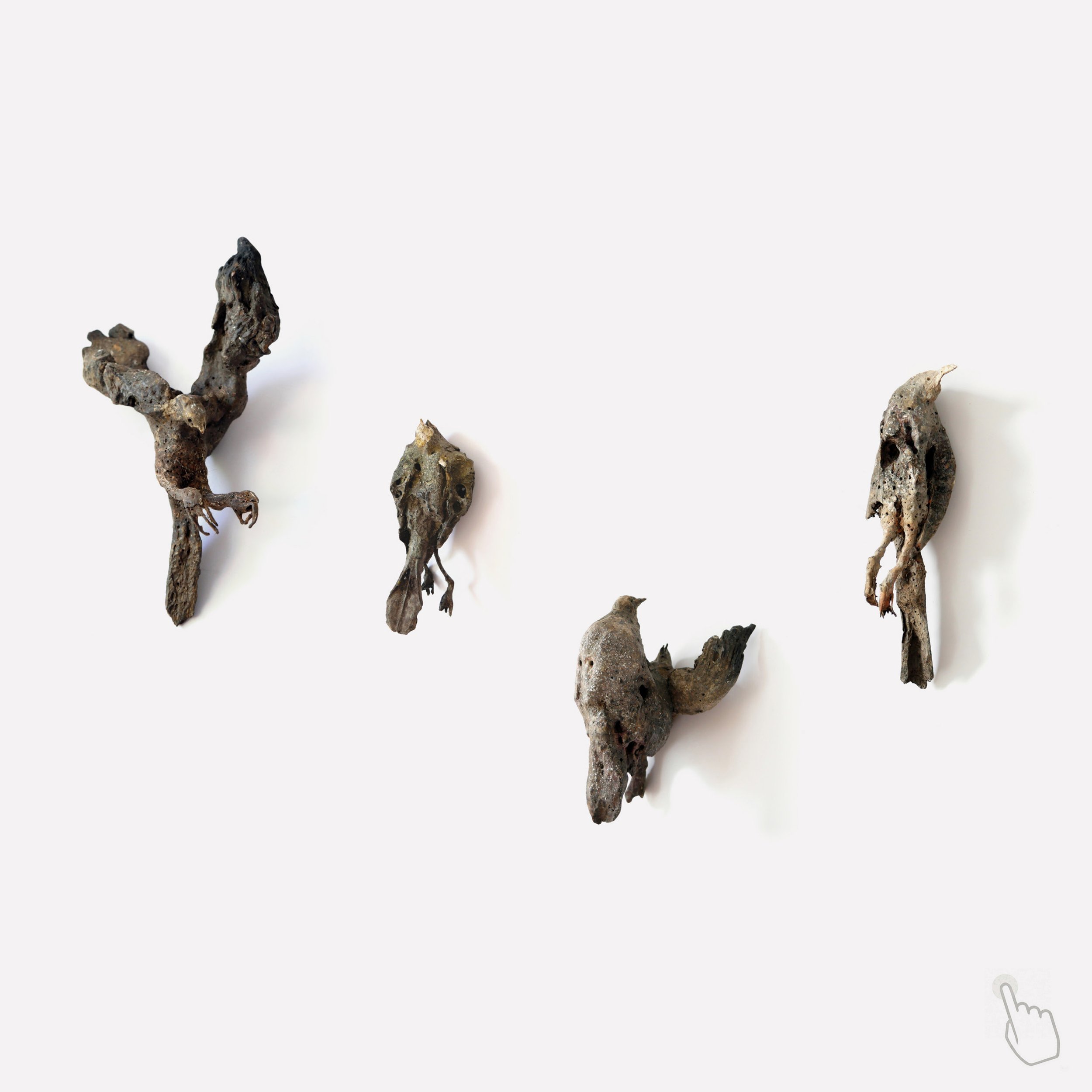
£0.00
Artist : Jim Carter
Title : Fen Temple, Torn Falcon / Green Sun Siskin (Plum Orchard) / Ossuary (Starling, Linnet, Crow) / February, March, April Rook
Medium : mixed media
Dimensions : 25 x 16 cm / 15 x 6 cm / 16 x 9 cm / 24 x 7 cm
ENQUIRE ABOUT THIS WORK
Often uneasy or tragic, irrational or other, Jim Carter’s work is linked to a real world of suffering and transcendence: making sculpture from organic materials as a means of advocacy, atonement or commemoration; shifting to story and the written word as a way to enter emotional and numinous spaces of memory and dream. What appears on the surface to be a wilful disturbance of the remains of organic life in order to fulfil a creative compulsion is intended to be part of a transforming and re-sanctifying process. Taken materials are reconfigured into new forms to express complex feelings of grief and loss, love and devotion, fertility and renewal. Fundamental in this work is a conviction in an irrepressible spirit for regeneration in the world, an imperishable flame that rises most clearly in landscape and the magic and otherness of animals.
Carter was born in Worcestershire in 1967. He received an MA with distinction in Art and Environment from Falmouth University and an MSc Award in Ecopsychology from the Centre For Human Ecology, Edinburgh. His work has appeared in Dark Mountain, Unpsychology and Earthlines magazine.

£0.00
Artist : Jim Carter
Title : I Slipped Through Bracken & Blackthorn Twigs - The Old Enchantment
Medium : paper, ash, bark, charcoal, adhesive, found wire, clay, remains of swallow nest, earth, debris, rain water, cow bone, bone black; rat, stoat, sheep and deer marks, fox and raven cuts
Dimensions : 32 x 24 cm
ENQUIRE ABOUT THIS WORK
Often uneasy or tragic, irrational or other, Jim Carter’s work is linked to a real world of suffering and transcendence: making sculpture from organic materials as a means of advocacy, atonement or commemoration; shifting to story and the written word as a way to enter emotional and numinous spaces of memory and dream. What appears on the surface to be a wilful disturbance of the remains of organic life in order to fulfil a creative compulsion is intended to be part of a transforming and re-sanctifying process. Taken materials are reconfigured into new forms to express complex feelings of grief and loss, love and devotion, fertility and renewal. Fundamental in this work is a conviction in an irrepressible spirit for regeneration in the world, an imperishable flame that rises most clearly in landscape and the magic and otherness of animals.
Carter was born in Worcestershire in 1967. He received an MA with distinction in Art and Environment from Falmouth University and an MSc Award in Ecopsychology from the Centre For Human Ecology, Edinburgh. His work has appeared in Dark Mountain, Unpsychology and Earthlines magazine.

£0.00
Artist : Jim Carter
Title : I Shook Off The Magpie (To Yarrow, Poplar, Marsh Marigold)
Medium : paper, ash, bark, charcoal, adhesive, found wire, clay, remains of wren and blackbird nest, soil from fox earth, debris, bone dust, willow leaf; fox, sheep, cow and deer marks
Dimensions : 31 x 25 cm
ENQUIRE ABOUT THIS WORK
Often uneasy or tragic, irrational or other, Jim Carter’s work is linked to a real world of suffering and transcendence: making sculpture from organic materials as a means of advocacy, atonement or commemoration; shifting to story and the written word as a way to enter emotional and numinous spaces of memory and dream. What appears on the surface to be a wilful disturbance of the remains of organic life in order to fulfil a creative compulsion is intended to be part of a transforming and re-sanctifying process. Taken materials are reconfigured into new forms to express complex feelings of grief and loss, love and devotion, fertility and renewal. Fundamental in this work is a conviction in an irrepressible spirit for regeneration in the world, an imperishable flame that rises most clearly in landscape and the magic and otherness of animals.
Carter was born in Worcestershire in 1967. He received an MA with distinction in Art and Environment from Falmouth University and an MSc Award in Ecopsychology from the Centre For Human Ecology, Edinburgh. His work has appeared in Dark Mountain, Unpsychology and Earthlines magazine.

£0.00
Artist : Jamie Mills
Title : Untitled, (Luminary Device)
Medium : feather, scrim, plaster, wax, pigment, chalk, quill, copper nail, wool
Dimensions : 30 x 15 cm
ENQUIRE ABOUT THIS WORK
Jamie Mills’ practice is underpinned by an investigation surrounding the dissemination of gesture between materiality and environments – referencing both internal and external landscapes. These concerns are reinforced by an interdisciplinary approach to working and are made manifest through the renderings of materials often sourced or retrieved via immersion into nature or borderlands The term ‘gestalt’ refers to a concept within psychotherapeutic fields, inferring that the nature of a whole is greater than the sum of its parts. Mills’ employment of the mediums of photography, sound and mark-making can be read in this sense whereby a reality is constructed not by the sole surface representation of any individual element alone, but instead there is a sense that the artists reality is presented through relationships and the spaces between elements. In other terms, it is work that requires both on one hand a stepping away from, and on the other an immersion into, in order to extract an empathetic understanding of the essence of the work that presides from both a conscious and subconscious framework of mind. Universally inherent within his process of rendering, there is a conscious dialogue between, on one hand material intent (or ‘essence’) and on the other, control (or the relinquishing of control), so as to make work that negotiates thresholds and occupies at times a liminal status. In this sense Mills’ “intuitively composed” sound works, and his images or assemblages become markers to a series of internal journeys or rituals informed by an often poetic dialogue between material, form and environment

£0.00
Artist : Jamie Mills
Title : Memory of Salt
Medium : paper, thread, quills, beeswax, resin, chalk, kaolin
Dimensions : 40 x 32 cm
ENQUIRE ABOUT THIS WORK
Jamie Mills’ practice is underpinned by an investigation surrounding the dissemination of gesture between materiality and environments – referencing both internal and external landscapes. These concerns are reinforced by an interdisciplinary approach to working and are made manifest through the renderings of materials often sourced or retrieved via immersion into nature or borderlands The term ‘gestalt’ refers to a concept within psychotherapeutic fields, inferring that the nature of a whole is greater than the sum of its parts. Mills’ employment of the mediums of photography, sound and mark-making can be read in this sense whereby a reality is constructed not by the sole surface representation of any individual element alone, but instead there is a sense that the artists reality is presented through relationships and the spaces between elements. In other terms, it is work that requires both on one hand a stepping away from, and on the other an immersion into, in order to extract an empathetic understanding of the essence of the work that presides from both a conscious and subconscious framework of mind. Universally inherent within his process of rendering, there is a conscious dialogue between, on one hand material intent (or ‘essence’) and on the other, control (or the relinquishing of control), so as to make work that negotiates thresholds and occupies at times a liminal status. In this sense Mills’ “intuitively composed” sound works, and his images or assemblages become markers to a series of internal journeys or rituals informed by an often poetic dialogue between material, form and environment

£0.00
Artist : Claire Curneen
Title : Siren
Medium : glazed terracotta
Dimensions : 72 x 36 x 32 cm
ENQUIRE ABOUT THIS WORK
Claire Curneen was born in Tralee, Co. Kerry, Ireland and currently lives and works in Wales, UK. Her iconic sculptures are poignant contemplations on the liminal and precarious nature of the human condition; exploring themes around death, rebirth and the sublime. Universal and profound states of fear, loss, suffering and sacrifice fuse with devotion, desire, wonder and mystery to underlie each intricate, porcelain figure. Their translucent and fragile qualities offer potent, metaphoric abstract narratives. Porcelain, terracotta and black stoneware create a grounded vulnerability to these works, with dribbles of glaze and flashes of gold to embellish denoted sacred qualities.
Works have been exhibited internationally and appear in many notable public collections including The Crafts Council, London; Shipley Art Gallery, Gateshead; National Museum & Gallery of Wales, Cardiff; Victoria and Albert Museum, London; The Fitzwilliam Museum, Cambridge; Manchester City Art Gallery, Manchester; National Museum of Scotland, Edinburgh; Aberystwyth Arts Centre, Aberystwyth, Wales; Cleveland Craft Centre, Middlesbrough; Oldham Art Gallery and Museum, Manchester; York City Art Gallery, York; Middlesbrough Institute of Modern Art, Middlesbrough; Crawford Art Gallery, Cork, Eire; Limerick City Gallery of Art, Limerick, Eire; Ulster Museum, Belfast, Northern Ireland; Benaki Museum, Athens, Greece; Clay Studio, Philadelphia. Recent exhibitions include ‘Alive & Unfolding’ at Le Delta, Namur (2025), and ‘Slipping the Veil’ at St Bartholomew the Great, London (2025). In 2025, her porcelain installation ‘Baroque and Berserk’ was acquired by the National Museum of Wales, Cardiff.

£0.00
Artist : Claire Curneen
Title : Figure with Bird
Medium : porcelain & gold lustre
Dimensions : 50 x 30 x 25 cm
ENQUIRE ABOUT THIS WORK
Claire Curneen was born in Tralee, Co. Kerry, Ireland and currently lives and works in Wales, UK. Her iconic sculptures are poignant contemplations on the liminal and precarious nature of the human condition; exploring themes around death, rebirth and the sublime. Universal and profound states of fear, loss, suffering and sacrifice fuse with devotion, desire, wonder and mystery to underlie each intricate, porcelain figure. Their translucent and fragile qualities offer potent, metaphoric abstract narratives. Porcelain, terracotta and black stoneware create a grounded vulnerability to these works, with dribbles of glaze and flashes of gold to embellish denoted sacred qualities.
Works have been exhibited internationally and appear in many notable public collections including The Crafts Council, London; Shipley Art Gallery, Gateshead; National Museum & Gallery of Wales, Cardiff; Victoria and Albert Museum, London; The Fitzwilliam Museum, Cambridge; Manchester City Art Gallery, Manchester; National Museum of Scotland, Edinburgh; Aberystwyth Arts Centre, Aberystwyth, Wales; Cleveland Craft Centre, Middlesbrough; Oldham Art Gallery and Museum, Manchester; York City Art Gallery, York; Middlesbrough Institute of Modern Art, Middlesbrough; Crawford Art Gallery, Cork, Eire; Limerick City Gallery of Art, Limerick, Eire; Ulster Museum, Belfast, Northern Ireland; Benaki Museum, Athens, Greece; Clay Studio, Philadelphia. Recent exhibitions include ‘Alive & Unfolding’ at Le Delta, Namur (2025), and ‘Slipping the Veil’ at St Bartholomew the Great, London (2025). In 2025, her porcelain installation ‘Baroque and Berserk’ was acquired by the National Museum of Wales, Cardiff.
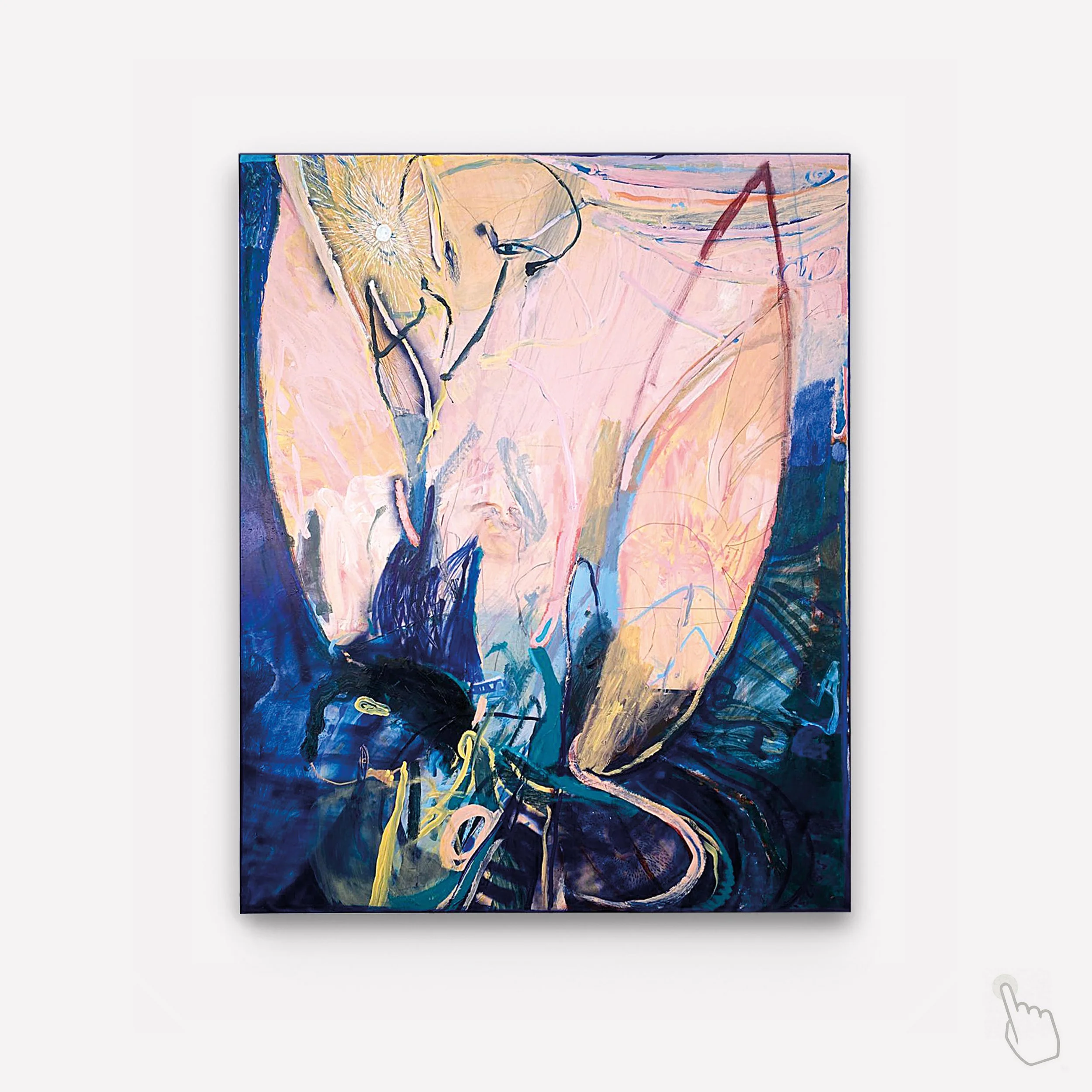
£0.00
Artist : Sam Bassett
Title : Trevalgan
Medium : acrylic on cavnvas
Dimensions : 180 x 120 cm
ENQUIRE ABOUT THIS WORK
“I woke up early, 5-ish in the hope that I’d go up Trevalgan Hill to see the sun rise and just be where my Gran’s ashes were scattered by my parents and family the week before. It’s where Granddad was scattered too, so I was keen to get there to, connect, talk, have a think you know, just be. The morning was misty and as I got closer to the hill, ascending, it got thicker and thicker. I finally got to the base of the hill and as I went through the gate I was met by two birds. I could only see about 10 yards ahead and these two danced and played with each other just steps in front of me to the very top of the hill. It was a dance, a celebration, a sign? I was delighted to see these two together. So happy, so playful, I cried, smiling and they joyfully led me to the top. I sat up top, with nothing to look at, they disappeared and I sat. I just sat, sitting pretty I was. It felt huge. No sun rise, nothing to see but that day I went home and started making drawings of birds. Over the past three years they’ve become upright. Walking. Figures. It’s funny what gets you started on something and funnier how it turns out.”
Sam Bassett was born in Cornwall, where he still lives and works. His work blends sharp humour, emotional intensity, and boundless experimentation. His distinctive visual language from sweeping gestures to more precise draughtsmanship and sgraffito schematics - channels the erratic clarity of an inner monologue unfolding on canvas. Described by some as a form of psychological cubism, his paintings reveal the interplay between internal and external worlds, exploring personal memory, cultural identity, and wider concerns about contemporary life. Autobiographical yet universally resonant, his recent works show a deepening connection to landscape, the sea, and his Cornish heritage — offering cautionary allegories of community, loss, and renewal.
Bassett has exhibited internationally, with solo shows at Vigo Gallery (London), Kornfeld Gallery (Berlin), and Anima Mundi (St Ives), as well as presentations at START (Saatchi Gallery) and CODE Art Fair (Copenhagen). His work is held in growing public and private collections, including Lost Karensa at Tremenheere Sculpture Park, permanently displayed alongside works by James Turrell, Richard Long and others. His practice has been profiled in Christie’s Magazine, The New York Post, and other publications, reflecting his rising influence and ambition.
£0.00
Artist : Judith Nangala Crispin
Title : There’s a door inside a nebula - where the dead go through. Marvin and Dorothy, still spinning, find one another on the other side of stars
Medium : lumachrome glass print, cliche-verse, chemigram. cat-killed New York chipmunk and grey squirrel on fibre paper. Re-exposed with sane, ochre, wax, house paint, Vegemite and sand. First exposure 13 hours under perspex in New York. Second exposure, 36 hours in a Braidwood greenhouse, edition of 10
Dimensions : 30 x 37 cm
ENQUIRE ABOUT THIS WORK
Judith Nangala Crispin is an Australian visual artist, poet and musician, and a descendant of Bpangerang people of North East Victoria. Her skin name, Nangala, was given to her by the Warlpiri people of the remote Tanami Desert in northern Australia, a place she has lived for a few months each year for over a decade. Her work includes themes of displacement and identity loss, a reflection on her ancestry, but it is primarily centred on the concept of connection with the land. This work forms a part of Crispin’s ongoing series depicting the transcendent ascending forms of recently deceased fauna. Crispin’s camera-less method of photography incorporates a range of processes. Her own developed alternative process of ‘lumachrome glass printing’, combines elements of lumen printing, cliché verre, chemical alchemy and drawing. She works within a mobile geodesic dome which functions as a giant lens where light streams penetrate its plastic walls. The mobility of her studio allows her to go to the site of her subject, prior to respectful burial. The muse, is raised onto a plastic box, rested on special photographic paper for up to 50 hours as the passage of sun and moonlight exposes its posthumous portrait. Each work is viewed as a collaboration with nature, where honouring the subject is a key objective. In each work the animals are diaphanous where light has literally passed through their bodies. They appear drawn in a primitive motion by a slipstream of spirit, levitating in a space of brooding luminosity that appears sentient and wholly focused on the task of enfolding each creature back into its care. The result offers a profound sense of what lies beyond.
Nangala Crispin has published a collection of poetry, The Myrrh-Bearers, and The Lumen Seed. She is a member of Oculi collective, one of the chapter leads of Women Photograph (Sydney), and was the 2021 Artist in residence with Music Viva. She is also the Poetry Editor for The Canberra Times. She has also directed and worked on two major social justice research projects – The Julfa Project; and Kurdiji 1.0, an Aboriginal suicide prevention app, which strengthens resilience in young indigenous people by reconnecting them with community and culture. Nangala Crispin work has been exhibited internationally.

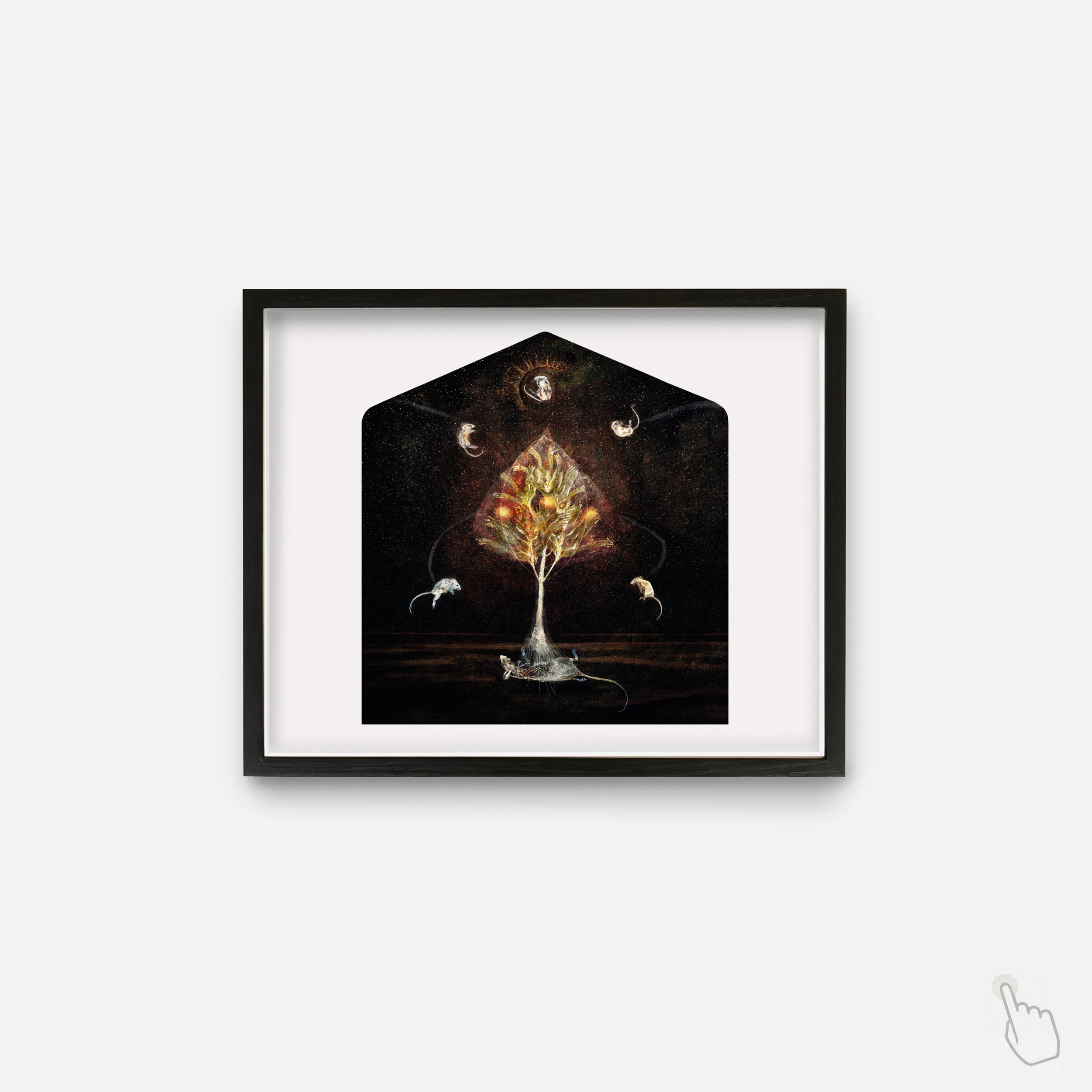
£0.00
Artist : Judith Nangala Crispin
Title : The Tree of Joyfulness erupts from the marrow of the First Rat. And its humming branches call the spirit rodents, those lost or returning to the source, and offers them shelter
Medium : lumachrome glass print, cliche-verre, chemigram, drawing, scan. Pressed kangaroo paw, dehydrated bush rat, five frost-killed marsupial mice with seeds, household chemicals, copper chloride, crayon, wax, vegemite and graphite on fibre paper. Exposed 37 hours in a greenhouse, edition of 10
Dimensions : 30 x 37 cm
ENQUIRE ABOUT THIS WORK
Judith Nangala Crispin is an Australian visual artist, poet and musician, and a descendant of Bpangerang people of North East Victoria. Her skin name, Nangala, was given to her by the Warlpiri people of the remote Tanami Desert in northern Australia, a place she has lived for a few months each year for over a decade. Her work includes themes of displacement and identity loss, a reflection on her ancestry, but it is primarily centred on the concept of connection with the land. This work forms a part of Crispin’s ongoing series depicting the transcendent ascending forms of recently deceased fauna. Crispin’s camera-less method of photography incorporates a range of processes. Her own developed alternative process of ‘lumachrome glass printing’, combines elements of lumen printing, cliché verre, chemical alchemy and drawing. She works within a mobile geodesic dome which functions as a giant lens where light streams penetrate its plastic walls. The mobility of her studio allows her to go to the site of her subject, prior to respectful burial. The muse, is raised onto a plastic box, rested on special photographic paper for up to 50 hours as the passage of sun and moonlight exposes its posthumous portrait. Each work is viewed as a collaboration with nature, where honouring the subject is a key objective. In each work the animals are diaphanous where light has literally passed through their bodies. They appear drawn in a primitive motion by a slipstream of spirit, levitating in a space of brooding luminosity that appears sentient and wholly focused on the task of enfolding each creature back into its care. The result offers a profound sense of what lies beyond.
Nangala Crispin has published a collection of poetry, The Myrrh-Bearers, and The Lumen Seed. She is a member of Oculi collective, one of the chapter leads of Women Photograph (Sydney), and was the 2021 Artist in residence with Music Viva. She is also the Poetry Editor for The Canberra Times. She has also directed and worked on two major social justice research projects – The Julfa Project; and Kurdiji 1.0, an Aboriginal suicide prevention app, which strengthens resilience in young indigenous people by reconnecting them with community and culture. Nangala Crispin work has been exhibited internationally.

£0.00
Artist : Judith Nangala Crispin
Title : In the garden of Namadji, a tree holds nine small birds in its arms, as they grieve for their friend beneath the earth
Medium :lumachrome glass print, cliche-verre, chemigram, drawing, scan. Ten still born Keats, pressed native fuchsia (Eremophila Latrobe), sea-water and vegemite on fibre paper. Exposed 21 hours in a polycarbonate greenhouse, edition of 10
Dimensions : 30 x 37 cm
ENQUIRE ABOUT THIS WORK
Judith Nangala Crispin is an Australian visual artist, poet and musician, and a descendant of Bpangerang people of North East Victoria. Her skin name, Nangala, was given to her by the Warlpiri people of the remote Tanami Desert in northern Australia, a place she has lived for a few months each year for over a decade. Her work includes themes of displacement and identity loss, a reflection on her ancestry, but it is primarily centred on the concept of connection with the land. This work forms a part of Crispin’s ongoing series depicting the transcendent ascending forms of recently deceased fauna. Crispin’s camera-less method of photography incorporates a range of processes. Her own developed alternative process of ‘lumachrome glass printing’, combines elements of lumen printing, cliché verre, chemical alchemy and drawing. She works within a mobile geodesic dome which functions as a giant lens where light streams penetrate its plastic walls. The mobility of her studio allows her to go to the site of her subject, prior to respectful burial. The muse, is raised onto a plastic box, rested on special photographic paper for up to 50 hours as the passage of sun and moonlight exposes its posthumous portrait. Each work is viewed as a collaboration with nature, where honouring the subject is a key objective. In each work the animals are diaphanous where light has literally passed through their bodies. They appear drawn in a primitive motion by a slipstream of spirit, levitating in a space of brooding luminosity that appears sentient and wholly focused on the task of enfolding each creature back into its care. The result offers a profound sense of what lies beyond.
Nangala Crispin has published a collection of poetry, The Myrrh-Bearers, and The Lumen Seed. She is a member of Oculi collective, one of the chapter leads of Women Photograph (Sydney), and was the 2021 Artist in residence with Music Viva. She is also the Poetry Editor for The Canberra Times. She has also directed and worked on two major social justice research projects – The Julfa Project; and Kurdiji 1.0, an Aboriginal suicide prevention app, which strengthens resilience in young indigenous people by reconnecting them with community and culture. Nangala Crispin work has been exhibited internationally.

£0.00
Artist : Tim Shaw
Title : Hallucinatory Figures & Bull on Hind Legs
Medium : bronze, edition of 8
Dimensions : 20 cm, 19 cm, 15 cm & 28 cm height
ENQUIRE ABOUT THIS WORK
Tim Shaw RA’s sculpture is often dualistic, incorporating current affairs, societal complexity and human conflict with ancient, mythical, metaphysical and primal concerns. Shaw’s powerful oeuvre connects these elements to create wider, timeless portraits of humanity. The tension between ancient past and a prosaic presence, between solidity and breakdown, becomes an organic part of his worldview, whether he’s looking at human transgression or the enlightenment of primitive ritual.
Shaw is a British artist, born in Belfast, he currently lives in Cornwall. He was elected an Academician at The Royal Academy in 2013 and made a Fellow of The Royal British Society of Sculptors and a Fellow of Falmouth University the same year. Shaw has had a number of significant solo shows throughout the UK, Ireland and internationally. Most recently the major public solo exhibitions ‘What Remains’ and ‘Something is Not Quite Right’ a collaboration between The Exchange and Anima-Mundi, ‘Mother the Air is Blue, The Air is Dangerous’ was held in the F.E McWilliam Gallery in Northern Ireland, ‘Black Smoke Rising’ toured from Mac Birmingham to Aberystwyth Arts Centre and Back From the Front presents: Shock and Awe – Contemporary Artists at War and Peace at the Royal West of England Academy. He has undertaken a number of public commissions including ‘The Rites of Dionysus’ for The Eden Project, ‘The Minotaur’ for The Royal Opera House and ‘The Drummer’ for Lemon Quay, Truro. A more political side to his work became evident in a number of sculptures responding to the issues of terrorism and The Iraq War. ‘Tank on Fire’ was awarded the selectors prize at the inaugural Threadneedle Prize in 2008 and the installation ‘Casting a Dark Democracy’ was reviewed in 2008 by Jackie Wullschlager of The Financial Times as ‘The most politically charged yet poetically resonant new work on show in London’. Shaw has been supported by the Kappatos Athens Art Residency, The Kenneth Armitage Foundation, The British School of Athens, The Delfina Studio Trust through residencies in Greece, Spain and a fellowship in London. Most recently as an Artist Fellow at the Kate Hamburger Centre for Advance Study in the Humanities of ‘Law & Culture’ In Bonn, Germany

£0.00
Artist : Paul Benney
Title : What Dark is This
Medium : textured copper plate etching on archival paper
Dimensions : 105 x 80 cm
ENQUIRE ABOUT THIS WORK
Paul Benney was born in London and currently lives and works in Suffolk, UK. He rose to international prominence as a member of the Soho and East Village Neo-Expressionist group, whilst living and working in NYC in the 1980s where he exhibited alongside peers such as Marilyn Minter, Jean-Michel Basquiat, and David Wojnarowicz, among many other. Despite being immersed in this extraordinary creative environment, Benney’s painting has always maintained a uniquely English sensibility.
His work is held in major collections including the Metropolitan Museum of Art in New York, the Brooklyn Museum, the National Gallery of Australia, the National Portrait Gallery in London, the Royal Collection, and the Eli Broad Foundation. He has exhibited in eight BP Portrait Award exhibitions and twice won the BP Visitors’ Choice Award. Benney’s portrait subjects have included HM Queen Elizabeth II, Sir Mick Jagger, John Paul Getty III, the 7th Marquess of Bath, the State Portrait for Israel, Lord Rothschild, and Ben Barnes for the feature film A Portrait of Dorian Gray. In 2010, Benney was invited to be resident artist at Somerset House, where he held his exhibition Night Paintings in 2012, drawing over 15,000 visitors. In 2017, his epic painting and holosonic sound installation Speaking in Tongues was a prominent feature of the Venice Biennale. Most recently, Benney completed the official state coronation portrait of Queen Camilla, continuing his longstanding role as a leading figure in contemporary British painting ‘What Dark is This’, an important early edition that won a U.S. National Print Prize in the 1980s and is held in the collection of the Zimmerli Museum, USA. Reflecting on the work, Benney notes: “Looking back, I guess I would add that although its meaning is deliberately somewhat ambiguous, my intention was to explore the male sexual drive, territorial aggression and confrontational nature that can exist side by side with the more aspirational human virtues such as courage, virtue and wisdom.”
Featured
£0.00
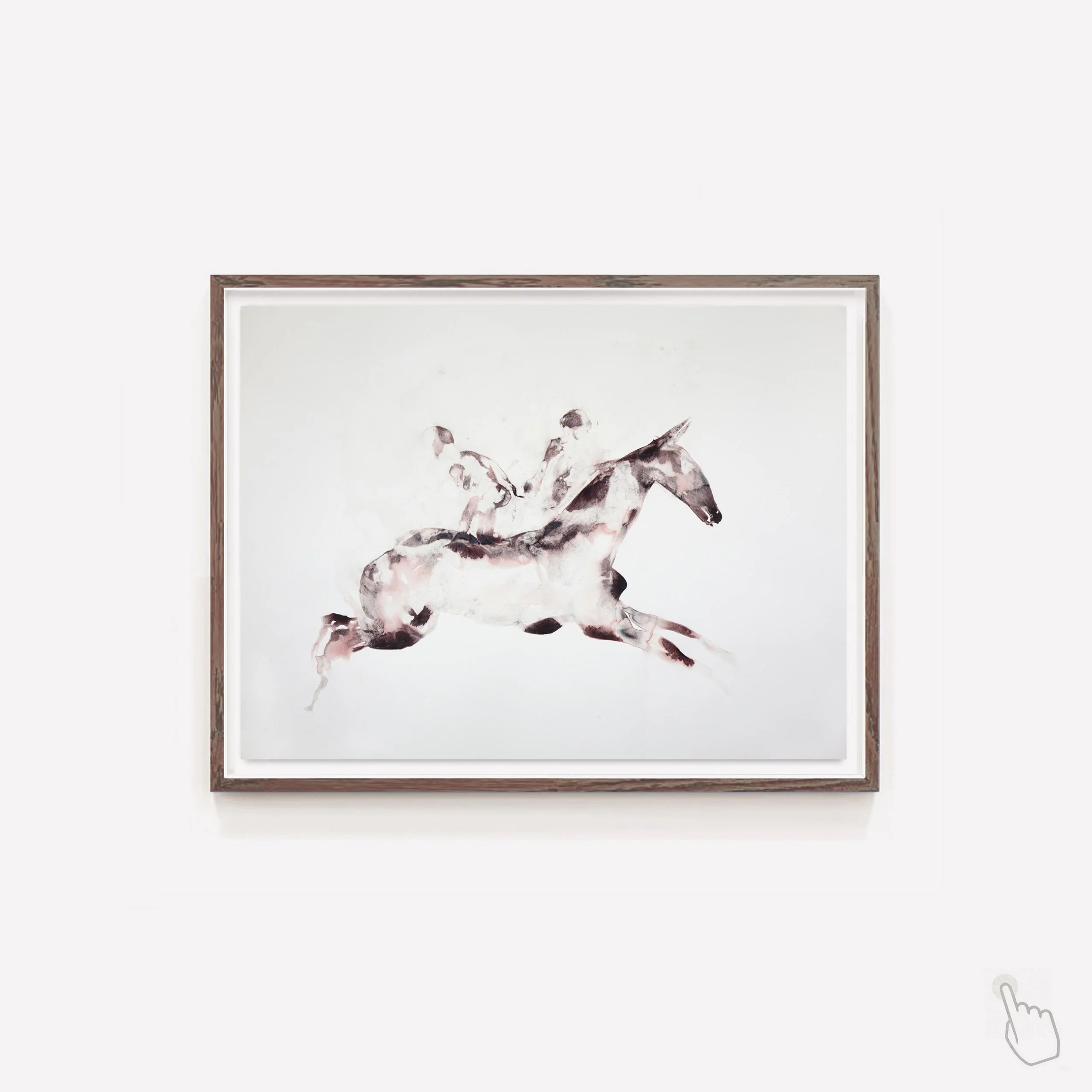
Artist : Kate Walters
Title : All Is Shadow
Medium : watercolour on paper
Dimensions : 50 x 70 cm
ENQUIRE ABOUT THIS WORK
Kate Walters is a British artist based in Penzance, West Cornwall. Her practice moves fluidly between painting, drawing, writing, and shamanic inquiry. Rooted in the symbolic and the visionary, her work channels inner states and liminal experience - engaging themes of birth, death, transformation, animality, and the maternal. Drawing on Jungian thought, myth, and embodied spiritual practice, Walters’ images often emerge from a process of trance or meditation, where animals, archetypes, and human figures appear as guides or thresholds. Using ink, watercolour, oil and mixed media, her intimate, gestural works possess both delicacy and ferocity - markings of vulnerability and ecstatic knowledge. The work is often diaristic, shaped by dream imagery and the retrieval of unconscious material through ritual, breathwork, and wilderness retreat.
Walters studied Fine Art at Falmouth and Painting at Brighton, later completing an MA at Wimbledon School of Art. Her work has been shown in solo and group exhibitions across the UK and internationally, including at Newlyn Art Gallery, The Royal West of England Academy, Bridport Arts Centre, and the Venice Biennale (2013, with the WW Gallery). She has undertaken residencies at places including the Isles of Iona and Shetland, Hospitalfield, and the Santa Fe Art Institute. Her writing and visual work have been published in EarthLines, Resurgence & Ecologist, and Numéro Cinq.

£0.00
Artist : Kate Walters
Title : How I Was Nourished
Medium : watercolour on paper
Dimensions : 56 x 76 cm
ENQUIRE ABOUT THIS WORK
Kate Walters is a British artist based in Penzance, West Cornwall. Her practice moves fluidly between painting, drawing, writing, and shamanic inquiry. Rooted in the symbolic and the visionary, her work channels inner states and liminal experience - engaging themes of birth, death, transformation, animality, and the maternal. Drawing on Jungian thought, myth, and embodied spiritual practice, Walters’ images often emerge from a process of trance or meditation, where animals, archetypes, and human figures appear as guides or thresholds. Using ink, watercolour, oil and mixed media, her intimate, gestural works possess both delicacy and ferocity - markings of vulnerability and ecstatic knowledge. The work is often diaristic, shaped by dream imagery and the retrieval of unconscious material through ritual, breathwork, and wilderness retreat.
Walters studied Fine Art at Falmouth and Painting at Brighton, later completing an MA at Wimbledon School of Art. Her work has been shown in solo and group exhibitions across the UK and internationally, including at Newlyn Art Gallery, The Royal West of England Academy, Bridport Arts Centre, and the Venice Biennale (2013, with the WW Gallery). She has undertaken residencies at places including the Isles of Iona and Shetland, Hospitalfield, and the Santa Fe Art Institute. Her writing and visual work have been published in EarthLines, Resurgence & Ecologist, and Numéro Cinq.

£0.00
Artist : Faye Eleanor Woods
Title : A Deer of Nine Colours
Medium : raw pigment, acrylic ink and chalk pastel on canvas
Dimensions : 102 x 82 cm
ENQUIRE ABOUT THIS WORK
Faye Eleanor Woods is a Scottish artist currently living and working in West Yorkshire. Her symbolic artwork acts as a love letter to her own experience, full of life’s joy, absurdity, humour, loss and fear. Recent works explore her own personal journey through grief, one she describes as dark, weepy and often humerous. She hails her work as a tangilble form of inner catharsis. Using raw pigments and acrylic ink she forces rich colour into the grain of the canvas, blurring edges with copious amounts of water or using thin layers of oil to blend the figures with their backgrounds creating an ethereal presence. As Woods says “I try to bring attention to the surreal aspects of life and the way the oddness of experience manifests within individuals and how that manifestation then affects me. In my vulnerability I crave strange moments of intimacy. I imagine drinking straight from the tap of all emotion, drinking so much of it, I take on too much and I’m sick and everything I spew out ends up in my work.”

£0.00
Artist : Andrew Hardwick
Title : Wind, Rain & Cows, Bodmin Moor
Medium : mixed media on panel
Dimensions : 30 x 42 cm
ENQUIRE ABOUT THIS WORK
Andrew Hardwick’s often large scale, sedimentary paintings display his captivation with ever decreasing wilderness zones; both natural and man-made. Playing with and subverting traditional notions of romantic landscape painting and the sublime. The paintings often depict edge-land zones around big industrial conurbations or ports, such as large-scale car storage compounds, redundant factories and polluted waste lands. Other works draw inspiration from the more typically idyllic locations such as Dartmoor and Bodmin Moor. However, these landscapes are also filled with reminders of human interference. Roads criss-cross the moor in deeply scratched lines, a narrow road is etched into an otherwise massive moorland triptych, likewise a real car radiator sits in the surface of another painting as if decaying and buried by the earth. His medium of working is also atypical, paintings are heavily layered with different types of paint (often sourced from recycling centres), plaster, plastics, soils, pigments, roofing felt, hay and other unconventional materials. To this rich surface relevant artefacts are often added, creating reminders, triggering memories or reflecting fears intrinsic to a particular landscape. The concept of layering in the landscape arrived partly a result of the artist’s childhood, during which his family’s farm was first sliced in half by the M5 motorway and then again by the Royal Portbury Dock. The land once filled with sheep has become a pure edge-land wilderness with detritus of continuous development now occupying and obliterating the land. Hardwick’s entire oeuvre makes reference to concepts of change, memory, history, emotion and transience. Ever redolent is the notion that we are but another layer in time.
Andrew Hardwick is a British artist born in Bristol, England in 1961 where he still resides. He achieved an MA in Fine Art at the University of Wales. He is an elected Academician at the Royal West of England Academy. He has featured in four solo exhibitions at Anima Mundi. Works have been exhibited extensively including numerous public shows and have been collected worldwide.

£0.00
Artist : Andrew Hardwick
Title : Sheep, Slopes, Dartmouth
Medium : mixed media on panel
Dimensions : 26 x 30 cm
ENQUIRE ABOUT THIS WORK
Andrew Hardwick’s often large scale, sedimentary paintings display his captivation with ever decreasing wilderness zones; both natural and man-made. Playing with and subverting traditional notions of romantic landscape painting and the sublime. The paintings often depict edge-land zones around big industrial conurbations or ports, such as large-scale car storage compounds, redundant factories and polluted waste lands. Other works draw inspiration from the more typically idyllic locations such as Dartmoor and Bodmin Moor. However, these landscapes are also filled with reminders of human interference. Roads criss-cross the moor in deeply scratched lines, a narrow road is etched into an otherwise massive moorland triptych, likewise a real car radiator sits in the surface of another painting as if decaying and buried by the earth. His medium of working is also atypical, paintings are heavily layered with different types of paint (often sourced from recycling centres), plaster, plastics, soils, pigments, roofing felt, hay and other unconventional materials. To this rich surface relevant artefacts are often added, creating reminders, triggering memories or reflecting fears intrinsic to a particular landscape. The concept of layering in the landscape arrived partly a result of the artist’s childhood, during which his family’s farm was first sliced in half by the M5 motorway and then again by the Royal Portbury Dock. The land once filled with sheep has become a pure edge-land wilderness with detritus of continuous development now occupying and obliterating the land. Hardwick’s entire oeuvre makes reference to concepts of change, memory, history, emotion and transience. Ever redolent is the notion that we are but another layer in time.
Andrew Hardwick is a British artist born in Bristol, England in 1961 where he still resides. He achieved an MA in Fine Art at the University of Wales. He is an elected Academician at the Royal West of England Academy. He has featured in four solo exhibitions at Anima Mundi. Works have been exhibited extensively including numerous public shows and have been collected worldwide.

£0.00
Artist : Andrew Hardwick
Title : Two Horses, Moor, Standing Stone
Medium : mixed media on panel
Dimensions : 26 x 30 cm
ENQUIRE ABOUT THIS WORK
Andrew Hardwick’s often large scale, sedimentary paintings display his captivation with ever decreasing wilderness zones; both natural and man-made. Playing with and subverting traditional notions of romantic landscape painting and the sublime. The paintings often depict edge-land zones around big industrial conurbations or ports, such as large-scale car storage compounds, redundant factories and polluted waste lands. Other works draw inspiration from the more typically idyllic locations such as Dartmoor and Bodmin Moor. However, these landscapes are also filled with reminders of human interference. Roads criss-cross the moor in deeply scratched lines, a narrow road is etched into an otherwise massive moorland triptych, likewise a real car radiator sits in the surface of another painting as if decaying and buried by the earth. His medium of working is also atypical, paintings are heavily layered with different types of paint (often sourced from recycling centres), plaster, plastics, soils, pigments, roofing felt, hay and other unconventional materials. To this rich surface relevant artefacts are often added, creating reminders, triggering memories or reflecting fears intrinsic to a particular landscape. The concept of layering in the landscape arrived partly a result of the artist’s childhood, during which his family’s farm was first sliced in half by the M5 motorway and then again by the Royal Portbury Dock. The land once filled with sheep has become a pure edge-land wilderness with detritus of continuous development now occupying and obliterating the land. Hardwick’s entire oeuvre makes reference to concepts of change, memory, history, emotion and transience. Ever redolent is the notion that we are but another layer in time.
Andrew Hardwick is a British artist born in Bristol, England in 1961 where he still resides. He achieved an MA in Fine Art at the University of Wales. He is an elected Academician at the Royal West of England Academy. He has featured in four solo exhibitions at Anima Mundi. Works have been exhibited extensively including numerous public shows and have been collected worldwide.
£0.00
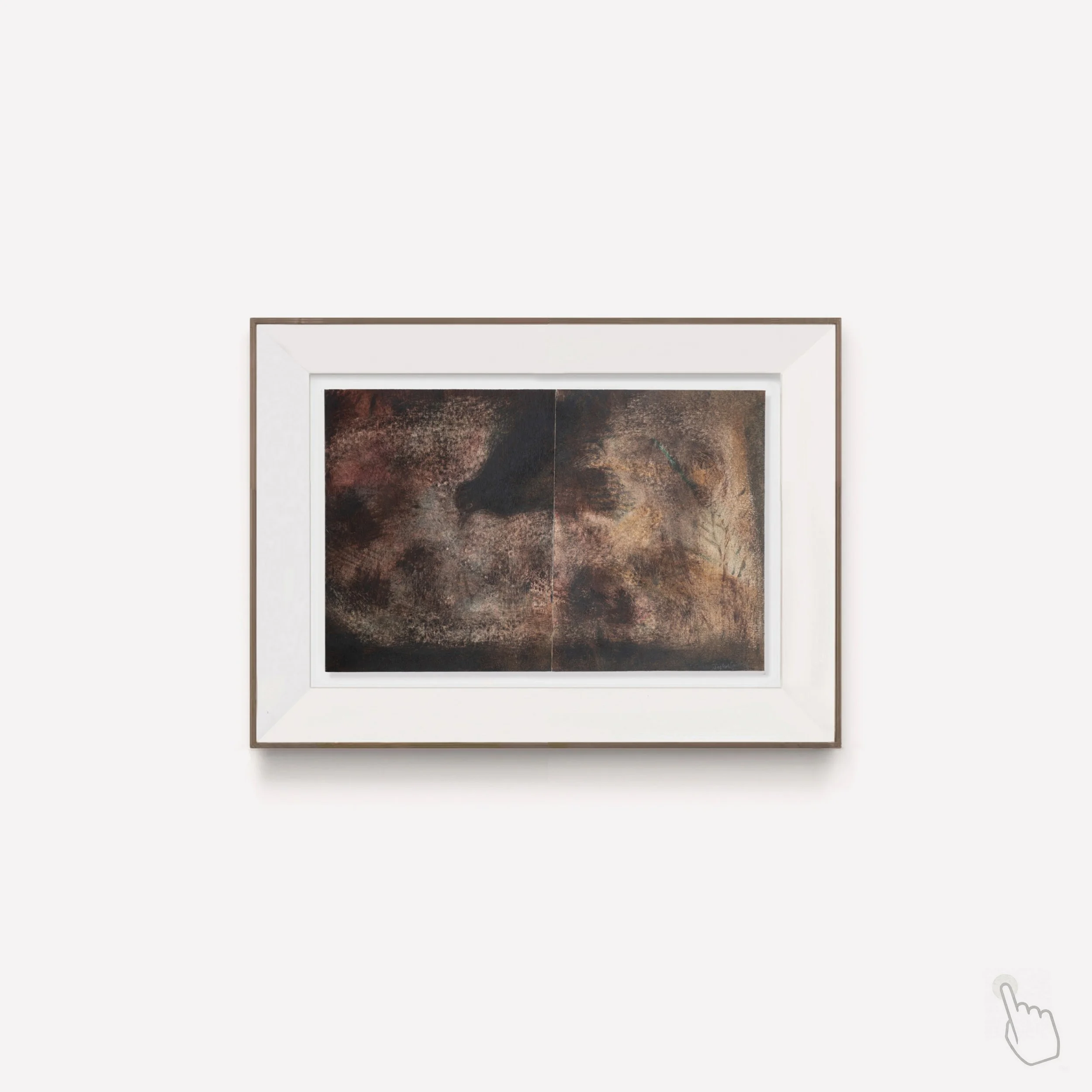
Artist : Joy Wolfenden Brown
Title : Home on the Wind
Medium : oil on paper
Dimensions : 20 x 31 cm
ENQUIRE ABOUT THIS WORK
Joy Wolfenden Brown’s intimate oil paintings feel hauntingly familiar, possessing a raw emotional, honesty. She captures fleeting fragments of memory, moments in time where the inherent vulnerability of the figures depicted, often in isolation, is palpable. These are lovingly yet spontaneously executed reflections on the human condition, which have an unnervingly, yet simultaneously comforting, unguarded quality.
Joy Wolfenden Brown is a British artist born in Stamford, Lincolnshire. She currently lives in Bude, North Cornwall. She graduated from Leeds University then completed a post-graduate diploma in Art Therapy at Hertfordshire College of Art & Design which she worked as for ten years before moving to Cornwall in 1999. Since then she has had numerous solo exhibitions and was the First Prize Winner in The National Open Art Competition, 2012. She was also awarded the Somerville Gallery painting prize in 2003 and first prize winner at the Sherborne Open in 2007 and the Evolver prize at The RWA in 2019 and the Judges Choice at the Chaiya Art Award 2023. Works were acquired by the Anthony Pettullo Outsider Art Collection in Milwaukee with further works held in collections worldwide.

£0.00
Artist : Joy Wolfenden Brown
Title : Night Song
Medium : oil on paper
Dimensions : 14 x 26 cm
ENQUIRE ABOUT THIS WORK
Joy Wolfenden Brown’s intimate oil paintings feel hauntingly familiar, possessing a raw emotional, honesty. She captures fleeting fragments of memory, moments in time where the inherent vulnerability of the figures depicted, often in isolation, is palpable. These are lovingly yet spontaneously executed reflections on the human condition, which have an unnervingly, yet simultaneously comforting, unguarded quality.
Joy Wolfenden Brown is a British artist born in Stamford, Lincolnshire. She currently lives in Bude, North Cornwall. She graduated from Leeds University then completed a post-graduate diploma in Art Therapy at Hertfordshire College of Art & Design which she worked as for ten years before moving to Cornwall in 1999. Since then she has had numerous solo exhibitions and was the First Prize Winner in The National Open Art Competition, 2012. She was also awarded the Somerville Gallery painting prize in 2003 and first prize winner at the Sherborne Open in 2007 and the Evolver prize at The RWA in 2019 and the Judges Choice at the Chaiya Art Award 2023. Works were acquired by the Anthony Pettullo Outsider Art Collection in Milwaukee with further works held in collections worldwide.

£0.00
Artist : Joy Wolfenden Brown
Title : Oh Dove
Medium : oil on paper
Dimensions : 14 x 26 cm
ENQUIRE ABOUT THIS WORK
Joy Wolfenden Brown’s intimate oil paintings feel hauntingly familiar, possessing a raw emotional, honesty. She captures fleeting fragments of memory, moments in time where the inherent vulnerability of the figures depicted, often in isolation, is palpable. These are lovingly yet spontaneously executed reflections on the human condition, which have an unnervingly, yet simultaneously comforting, unguarded quality.
Joy Wolfenden Brown is a British artist born in Stamford, Lincolnshire. She currently lives in Bude, North Cornwall. She graduated from Leeds University then completed a post-graduate diploma in Art Therapy at Hertfordshire College of Art & Design which she worked as for ten years before moving to Cornwall in 1999. Since then she has had numerous solo exhibitions and was the First Prize Winner in The National Open Art Competition, 2012. She was also awarded the Somerville Gallery painting prize in 2003 and first prize winner at the Sherborne Open in 2007 and the Evolver prize at The RWA in 2019 and the Judges Choice at the Chaiya Art Award 2023. Works were acquired by the Anthony Pettullo Outsider Art Collection in Milwaukee with further works held in collections worldwide.
Artist : Lena Dabska
Title : Hunted
Medium : lithodraph on paper, edition of 10
Dimensions : 50 x 70 cm
ENQUIRE ABOUT THIS WORK
Lena Dabska is a Polish artist currently in her fourth year of study at the Academy of Fine Arts in Warsaw. Her practice centres around an expansive exploration of femininity and feminine power, informed by personal experience and a deep intuitive connection to nature. At the core of her work lies a belief in womanhood as a primal, untameable force. Through ongoing experimentation, while remaining grounded in the intuitive, bodily, and symbolic, her work offers a vision of feminine energy as both fierce and nurturing — a return to source. Recurring totemic motifs embody strength, freedom, and an ancient, sacred femininity. A sense of mythic vitality persists — a reminder of the shared lineage between humans and the natural world.